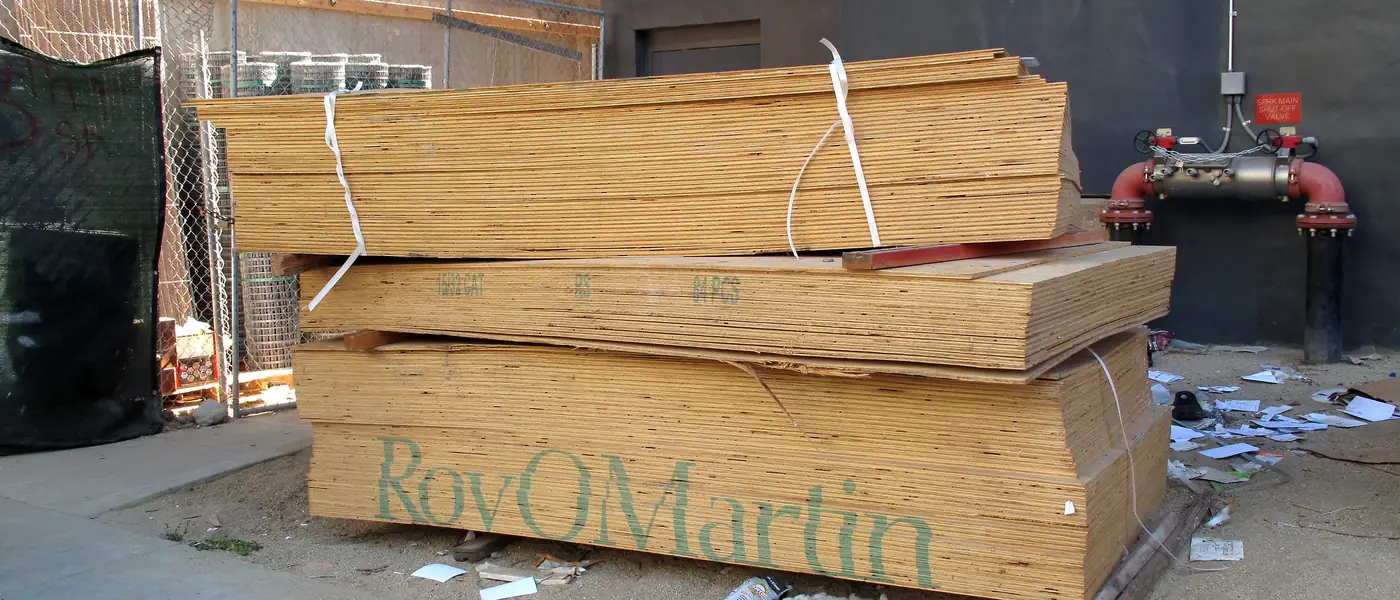
Plywood is bought in whole sheets, most commonly 8 × 4 ft (2440 × 1220 mm). Every cabinet, wardrobe or bed is really a list of rectangles that must be cut from those sheets. There are two ways to count the sheets, and the difference between them is where money is lost.
Step 1: make a panel list
Write every part as length × width × quantity, grouped by board thickness. A simple base cabinet 900 mm wide, 720 mm tall and 560 mm deep in 18 mm board looks like this:
| Part | Size (mm) | Qty | Board |
|---|---|---|---|
| Side | 720 × 560 | 2 | 18 mm |
| Top and bottom | 864 × 560 | 2 | 18 mm |
| Shelf | 864 × 540 | 1 | 18 mm |
| Shutter | 717 × 447 | 2 | 18 mm |
| Back | 720 × 900 | 1 | 6 mm |
The top, bottom and shelf are 864 mm because they sit between two 18 mm sides: 900 − 2 × 18 = 864.
Step 2: the area method (a minimum)
An 8 × 4 sheet is 2.44 × 1.22 = 2.98 m². The 18 mm parts above total about 2.88 m², so by area alone they "fit" in one sheet. In practice they will not. Area ignores the shape of the pieces, the saw cut between them and the offcuts that are too small to use.
Step 3: the layout method (what you actually buy)
Lay the parts out on sheet-sized rectangles, largest first, leaving the width of the saw blade (the kerf, usually 3–4 mm) between cuts. Parts that are nearly as wide as half a sheet often leave a strip that cannot be used. When the layout needs a second sheet, buy two.
Allowances to remember
- Kerf: each cut removes 3–4 mm. Ten cuts across a sheet is 30–40 mm.
- Factory edges: many carpenters trim a few millimetres off damaged or uneven sheet edges before marking out.
- Grain and laminate direction: veneered and pre-laminated boards look wrong if the grain runs the other way on matching doors. Rotate pieces only where it will not show.
- Separate thicknesses: 18 mm carcass, 12 mm drawers and 6 mm backs are separate sheets. Count each group on its own.
Do it on your phone
Enter the panel list in the NANDIX cut list: it groups panels by thickness, draws a cutting layout for every sheet and adds up edge banding. For a standard box cabinet, the cabinet estimator builds the panel list for you from width, height and depth.