Wood is one of the most expensive materials in a house, and one of the easiest to get wrong. The right timber depends on where it goes: a main door frame must resist termites and weather for decades, while a bedroom wardrobe mostly needs to stay flat.
Common timbers and where they suit
| Timber | Character | Good for | Notes |
|---|---|---|---|
| Teak | Durable, stable, naturally resists termites and decay; heartwood golden brown | Main doors and frames, windows, quality furniture | Most expensive. Plantation teak varies a lot in quality |
| Sal | Very hard, heavy, strong and durable | Door and window frames (chaukhat), structural use | Hard to work; can crack if not seasoned well |
| Sheesham (Indian rosewood) | Hard, attractive grain, polishes well | Furniture, cabinets | Seasoning matters; costlier than common hardwoods |
| Rubberwood | Light, even texture, plantation grown | Budget furniture, interior items | Must be chemically treated; not for outdoor use |
| Pine (mostly imported) | Light softwood, knots, easy to work | Budget furniture, interior panelling | Treat against termites and borers |
| Meranti and other imported hardwoods | Moderately durable, straight grain | Frames and shutters as a teak substitute | Quality and species vary; ask exactly what it is |
| Neem, mango and local hardwoods | Variable | Economy frames, furniture | Mango and similar woods need treatment |
Slow-grown and fast-grown teak
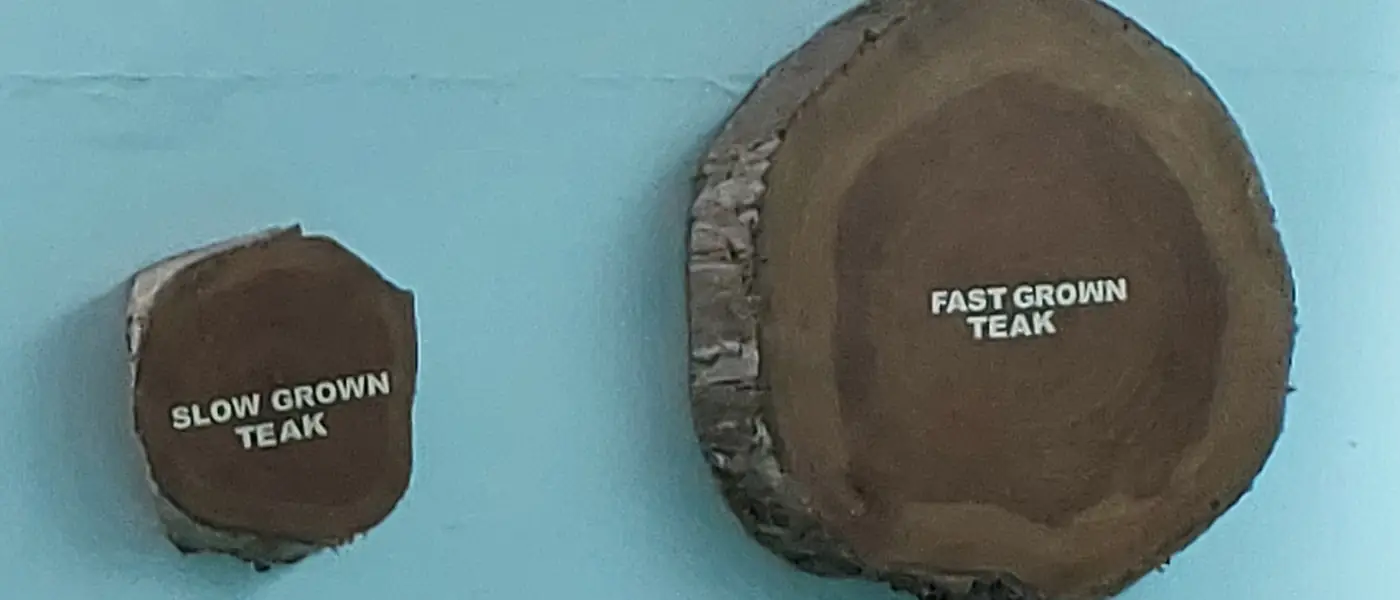
The photo above, from the Nilambur Teak Museum in Kerala, shows the difference. Slow-grown teak has dense, narrow growth rings and a large proportion of dark heartwood, the durable part. Fast-grown plantation teak is larger for its age but has wider rings and more pale sapwood, which is less durable and more prone to insects. Both are sold as "teak", at very different real value.
Checking timber before you buy
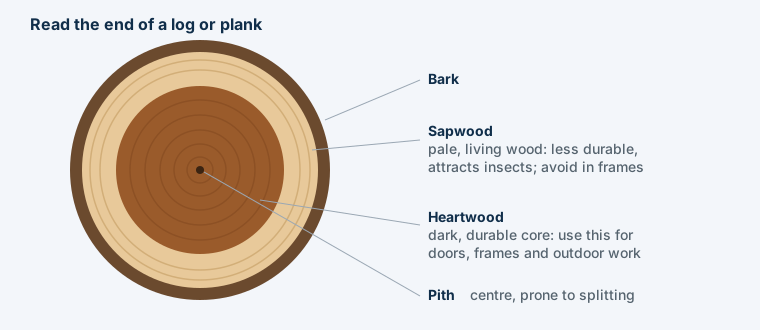
- Heartwood, not sapwood. Heartwood is darker and more durable. Frames and outdoor work should be all heartwood.
- Seasoning. Wood must be dried to suit its use before it is worked, or it shrinks, warps and opens joints later. Kiln-dried timber is the most reliable. IS 287 gives the moisture content suitable for each use and climate; ask the supplier for the moisture reading.
- Straight grain. Grain running across a frame member makes it weak and liable to split.
- Knots. Small, tight knots are acceptable in furniture. Avoid large or loose knots in frames and load-bearing pieces.
- No cracks, splits or shakes, especially at the ends of planks.
- No borer holes or powder, which mean live insects.
- Real sizes. Measure the actual section; "4 × 3" is often less after sawing and planing.
Treatment against termites and borers
Every timber except the most durable heartwood should be treated with a preservative before use, following IS 401. This matters most for rubberwood, pine, mango and sapwood, and for any wood touching walls or floors. Treated wood combined with anti-termite treatment of the soil is what keeps frames safe for decades.
When plywood and boards are better
For wardrobes, kitchen cabinets, beds and wall panelling, engineered boards are usually better value and more stable than solid wood:
- Plywood (IS 303) comes in grades for interior use (MR, moisture resistant) and wet areas (BWR/BWP). Marine plywood (IS 710) is for the wettest places.
- Block board is light and stays flat over long spans such as wardrobe doors.
- MDF and HDHMR give smooth surfaces for painted and routed finishes.
The draft guides how to choose plywood for your home and plywood vs MDF vs HDHMR go into more detail.
Working out quantities and cost
Solid timber is sold by volume in cubic feet (CFT). The wood CFT calculator turns sizes into CFT and cost and draws each piece to scale, and the door estimator works out frame wood for each door. For boards, the sheet calculator gives the number of 8 × 4 sheets with a cutting layout.