The foundation, columns, beams and slabs of your house are concrete. How strong they end up depends less on the brand of cement than on four things done on site: the mix, the water, the pouring and the curing.
What the grade means
Concrete grades are written as M followed by a number: M20, M25, M30. The number is the strength, in N/mm², that 150 mm test cubes must reach after 28 days.
IS 456 sets a minimum grade for reinforced concrete depending on how harsh the surroundings are: M20 for mild conditions (most inland houses), M25 for moderate, and higher for severe exposure such as a coastal site. Your structural engineer chooses the grade; don't let it be reduced on site.
Nominal mix or design mix
- Nominal mix uses fixed proportions by volume, such as 1 : 1.5 : 3 (cement : sand : aggregate) for M20. IS 456 allows nominal mixes up to M20.
- Design mix is worked out by a lab for your materials to reach the target strength reliably (IS 10262). It is required for M25 and above, and is what ready-mix plants supply.
The concrete calculator works out the volume and the cement, sand and aggregate for nominal mixes. How to calculate concrete quantity shows the working.
Ready-mix or site-mix?
| Ready-mix (RMC) | Site-mixed | |
|---|---|---|
| Quality | Weighed batching, more consistent | Depends on the supervisor |
| Speed | Fast, especially for slabs | Slower |
| Best for | Roof slabs and large pours | Small quantities, narrow access |
| Watch | Delivery time, and no water added on site | Measuring boxes, mixing time |
Water: the biggest enemy of strength
Adding water makes concrete easier to pour and much weaker. Every extra bucket raises the water–cement ratio, which is what really decides strength and durability. IS 456 limits it to 0.55 for mild exposure and 0.50 for moderate.
Pouring and compacting
- Before the pour: formwork tight and propped, steel checked and approved, cover blocks in place, the surface wetted.
- Pour continuously. Plan labour, materials and power so a slab is finished in one go.
- Don't drop concrete from a height. The stones separate from the paste (segregation), leaving weak, honeycombed patches.
- Compact with a needle vibrator, inserted at short, regular spacings and withdrawn slowly. Stop when air bubbles stop rising; over-vibrating also causes segregation.
- Make test cubes from the slab concrete and get them tested at 7 and 28 days.
Curing: the step most sites skip
Concrete does not dry to gain strength; it gains strength by reacting with water. If it dries out in the first week, it stays weaker and cracks, for good.
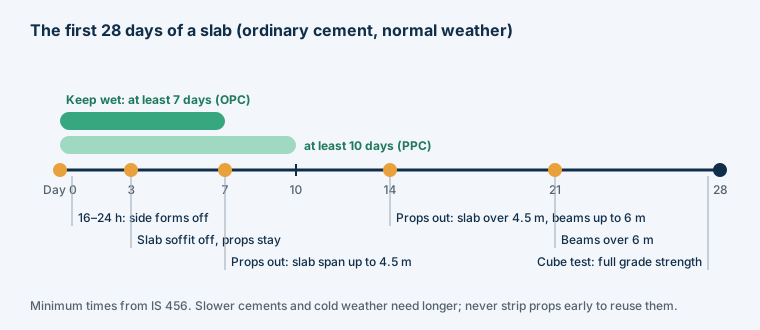
Start curing as soon as the surface has hardened enough not to be marked: pond water on slabs using small mud or mortar bunds, and keep columns and beams wrapped in wet hessian. IS 456 calls for keeping concrete moist for at least 7 days with OPC and at least 10 days with PPC or other blended cements, and longer in hot, dry weather.
When can the formwork come off?
IS 456 gives minimum times for ordinary cement in normal weather:
| Formwork | Minimum time |
|---|---|
| Vertical faces of columns, walls and beams | 16–24 hours |
| Slab soffit (with props left under it) | 3 days |
| Beam soffit (with props left under it) | 7 days |
| Props under slabs up to 4.5 m span | 7 days |
| Props under slabs over 4.5 m span | 14 days |
| Props under beams up to 6 m span | 14 days |
| Props under beams over 6 m span | 21 days |
Slower-gaining cements and cold weather need longer. Never remove props early to reuse them on the next floor.