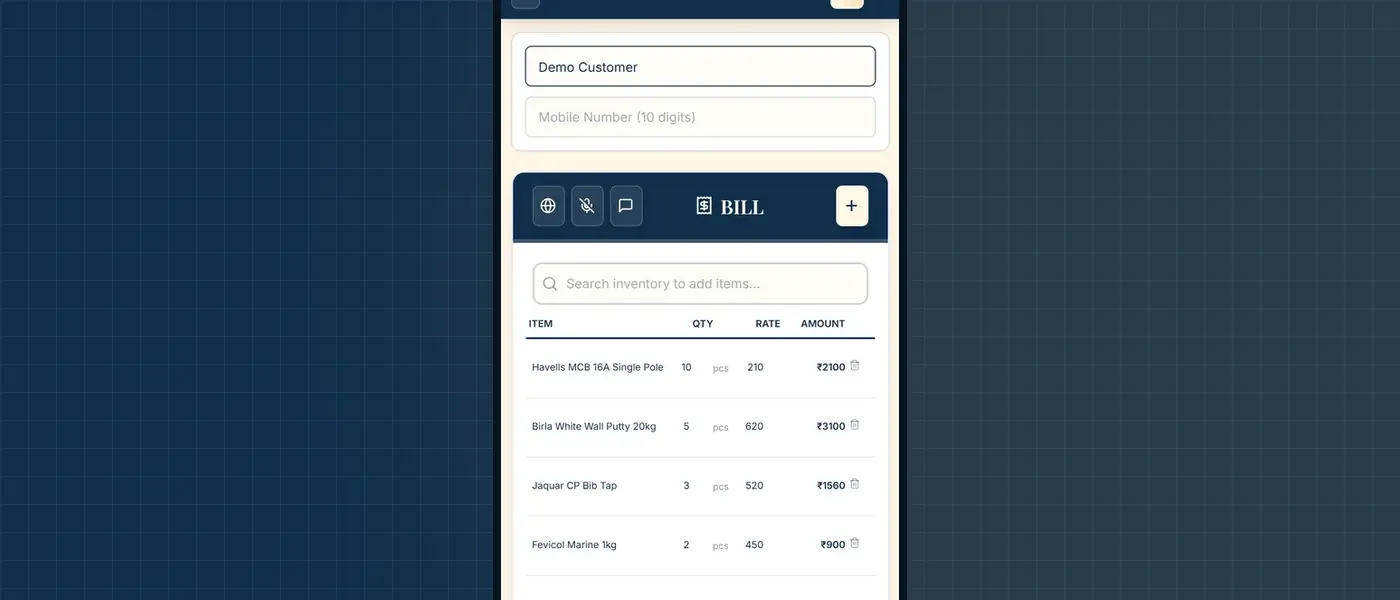
A hardware store issues hundreds of bills a month, and many miss something GST requires: usually the HSN code, the customer's GSTIN, or a clean invoice-number series. This is a plain-language checklist of what a valid tax invoice contains.
Tax invoice or bill of supply?
- Regular GST-registered store: issues a tax invoice and charges GST.
- Store under the composition scheme: cannot charge GST. It issues a bill of supply with the words "composition taxable person, not eligible to collect tax on supplies" at the top.
Mandatory fields on a tax invoice
- Your name, address and GSTIN
- A consecutive invoice number of up to 16 characters (letters, numbers, hyphen or slash), unique for the financial year, e.g.
HW/26-27/0452 - Date of issue
- Customer's name, address and GSTIN, if registered
- For an unregistered customer with a taxable value of ₹50,000 or more: name, address, delivery address, and state name and code
- HSN code for each item
- Description
- Quantity and unit
- Total value
- Taxable value after any discount
- Rate of tax: CGST and SGST, or IGST (and cess if any)
- Amount of tax
- Place of supply with state name, for inter-state sales
- Delivery address, if different from the place of supply
- Whether tax is payable on reverse charge
- Signature or digital signature of the supplier or an authorised person
HSN digits
| Annual turnover (previous year) | HSN digits on tax invoices |
|---|---|
| Up to ₹5 crore | 4 digits on B2B invoices (optional on B2C) |
| More than ₹5 crore | 6 digits on all tax invoices |
Common headings in a hardware store include 3917 (plastic pipes and fittings), 7318 (screws, bolts, nuts), 8481 (taps and valves), 8536 (switches and electrical fittings up to 1,000 V), 8544 (insulated wires and cables), 3208/3209 (paints), 2523 (cement) and 7214 (steel bars). The exact code depends on the product; confirm your top sellers once with your CA and save the code against each item.
CGST + SGST or IGST
- Customer in the same state: CGST + SGST in equal halves. At 18%, that is 9% + 9%.
- Customer in another state: IGST at the full rate, with the place of supply shown.
Numbering: the rule stores break most
Numbers must run in sequence and be unique in the financial year. Do not reuse or skip numbers without a record; a cancelled invoice keeps its number in your records and is reported in the documents-issued section of GSTR-1. Paper bill books with several counters make duplicates easy. Billing software should make them impossible.
Small sales under ₹200
For a sale below ₹200 to an unregistered customer who does not ask for an invoice, you may skip the individual invoice but must issue one consolidated tax invoice for all such sales at the end of the day.
Returns: use a credit note
When a customer returns goods, do not edit or delete the original invoice. Issue a credit note referring to it, so that sales and tax reduce correctly.